Stars and Planets

—Birth—
Chris Ormel

Roadmap module 5
Initial Mass Function (IMF)
The initial distribution of stars (after their formation) by their mass
Virial Theorem
A fundamental relation between kinetic/thermal energy and gravitational energy for "relaxed" systems of many particles (stars as well as gas). Frequently employed by astronomers to find the "dynamical mass".
Jeans Mass
a critical mass above which the cloud will collapse
Dispersion relationship
A relation how a fluid responds to perturbations on a certain scale. A frequently used tool to investigate whether fluids are stable
Protoplanetary Disks
The environment where planets are born
Disk instability and core accretion
Planet formation models that describe the formation of terrestrial planets, the cores of giant planets, and gas giants
- Toomre Q criterion
- Giant planet formation
- planetesimal formation
- Coagulation
- Gravitational focusing
- Pebble accretion
Virial Theorem and Star Formation
- Virial theorem
- Cloud collapse
- Cloud fragmentation
Virial theorem
— read CO 2.4 —
- The
Virial Theorem
postulates that
for self-gravitating systems:
-
![]() for an N-particle system;
for an N-particle system;
-
![]() for gaseous objects
for gaseous objects
where nvir is a positive number, T is the kinetic, Uint the internal energy and W the total gravitational (potential) energy and <..> denotes the time-average. In other words, the virial theorem holds when the system has relaxed into a steady configuration.
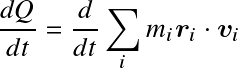
Proof goes along these lines. The quantity
![]()
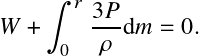
time-averages to 0. Q (the "virial") is itself the derivative of the moment of inertia. For a gravitating gas, we derive from the hydrostatic balance equation
![]()
To proceed,
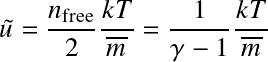
![]() must be linked to the internal energy per unit mass
must be linked to the internal energy per unit mass
![]() . For an ideal gas this is just
. For an ideal gas this is just
![]()
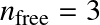
where
![]() is the number of free degrees and
is the number of free degrees and
![]() is the heat capacity ratio. For a mono-atomic gas,
is the heat capacity ratio. For a mono-atomic gas,
![]() ,
,
![]() and
and
![]() .
.
-








Virial theorem
— read CO 2.4 —
- The
Virial Theorem
postulates that
for self-gravitating systems:
-
![]() for an N-particle system;
for an N-particle system;
-
![]() for gaseous objects
for gaseous objects
where nvir is a positive number, T is the kinetic, Uint the internal energy and W the total gravitational (potential) energy and <..> denotes the time-average. In other words, the virial theorem holds when the system has relaxed into a steady configuration.
-
- Specific examples include:
-
![]() (fully ionized or mono-atomic gas)
(fully ionized or mono-atomic gas)
-
![]() (radiation gas)
(radiation gas)
-




Virial theorem
— read CO 2.4 —
- The
Virial Theorem
postulates that
-
![]() for an N-particle system;
for an N-particle system;
-
![]() (fully ionized or mono-atomic gas)
(fully ionized or mono-atomic gas)
-
![]() (radiation gas)
(radiation gas)
-
- The virial theorem is not the same as energy conservation!
Conservation of energy dictates that
![]() where
the total energy
where
the total energy
![]() is conserved in an isolated system. Hence we obtain that objects in virial equilibrium
obey
is conserved in an isolated system. Hence we obtain that objects in virial equilibrium
obey
![]() (a different prefactor may apply if the gas is not mono-atomic).
(a different prefactor may apply if the gas is not mono-atomic).
Note — the expression for the virial theorem can be extended to include magnetic support, rotational support etc.






Virial theorem
— read CO 2.4 —
- The
Virial Theorem
postulates that
-
![]() (fully ionized or mono-atomic gas)
(fully ionized or mono-atomic gas)
-
![]() (radiation gas)
(radiation gas)
-
- The virial theorem is not the same as energy conservation!
- Applications:
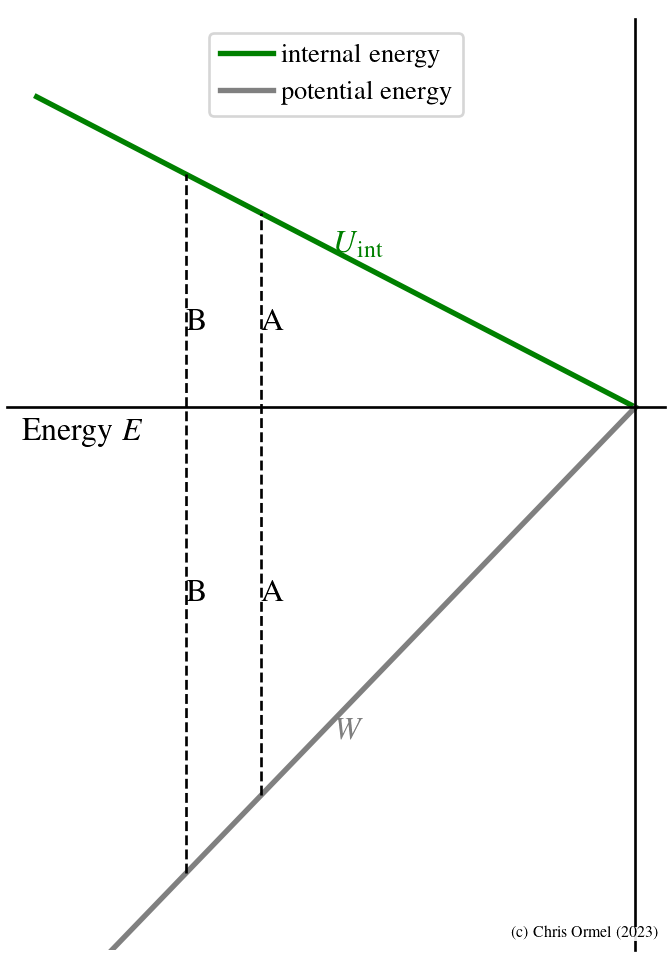
- (Proto-)stars heat up when they contract:
![]()
Protostars (no nuclear burning) lose energy. Of the gravitational energy liberated during contraction, half is radiated and the other half goes into internal energy. Stars heat up while loosing energy!
This corresponds to moving from state A → B in the figure right - Stars are thermodynamically stable
They expand and cool down when their total energy E increases (!). This corresponds to moving from B → A in the figure right. This kind of "virial stability" only applies to the ideal gas law.
- Obtain the (dynamical) mass by measuring the linewidth.
- (Proto-)stars heat up when they contract:



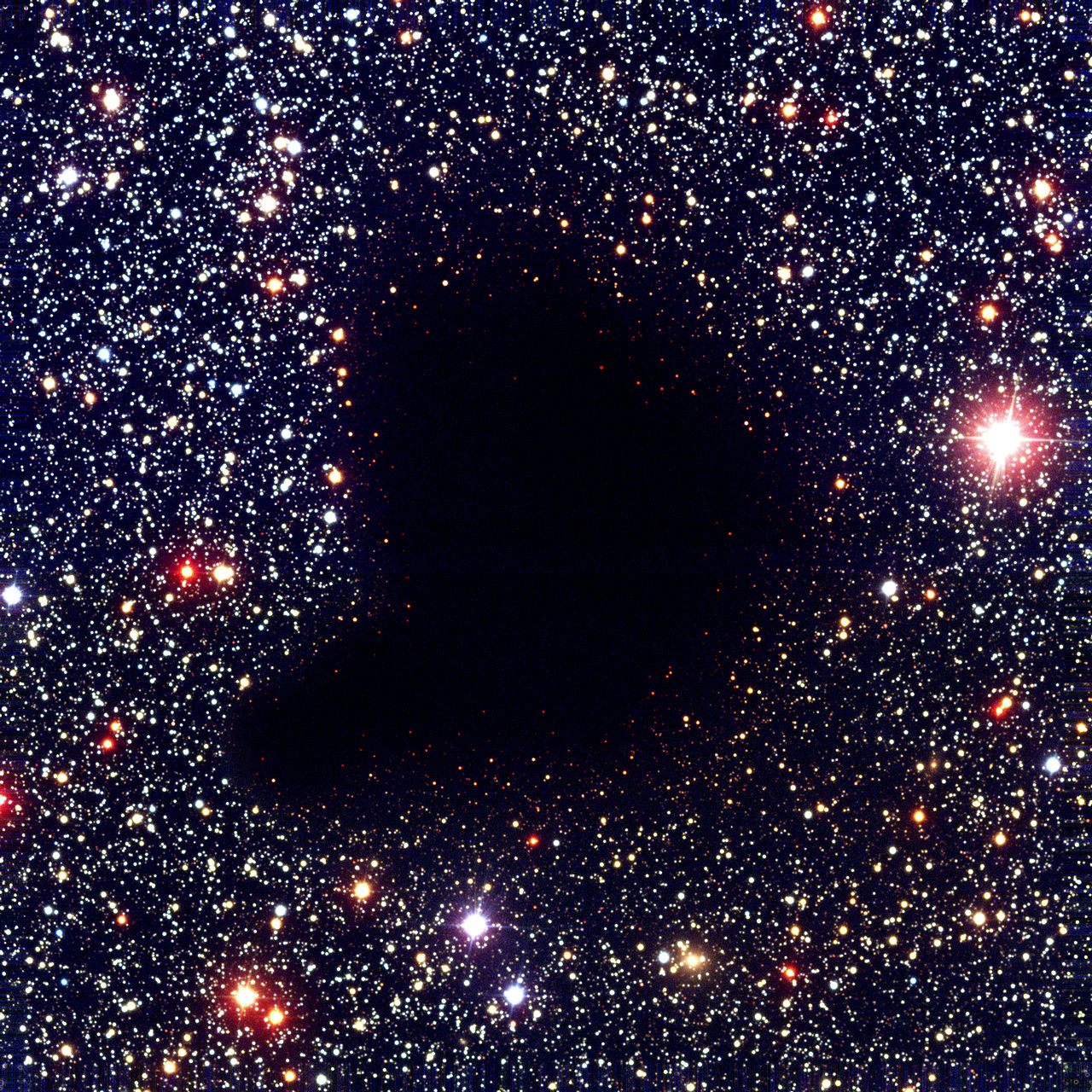
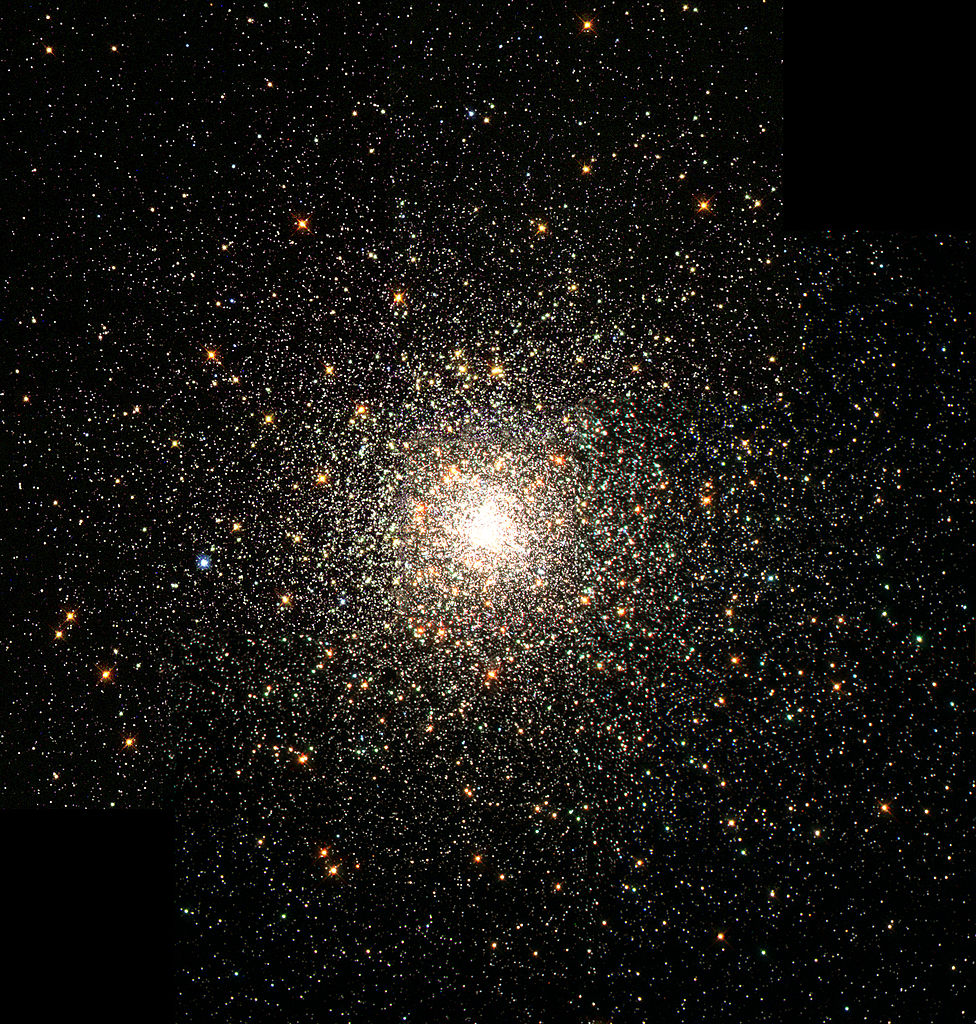
Virial Theorem — applications
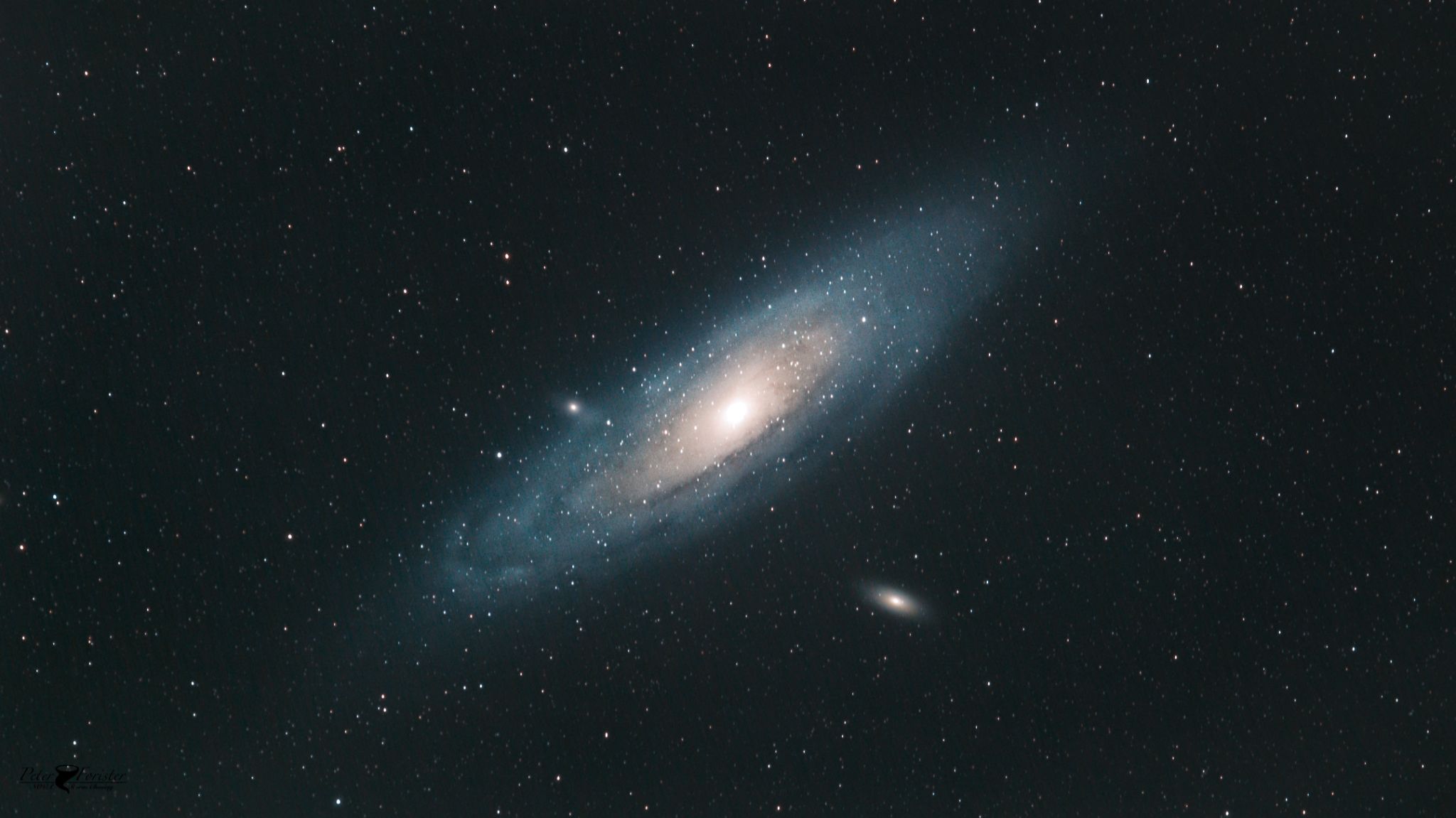
Andromeda-Milky Way merger
The Andromeda galaxy will be merging with the Milky Way galaxy in a few billion years. Assume the galaxies are equal in their properties (mass, size, rotation velocity) and that the merger product is again a spiral galaxy.
By the virial theorem, what is the rotational velocity of the merger galaxy?
- lower than the present-day
- the same
- higher than the present-day
Also, what is the radius R of the merger galaxy?
- slightly smaller than the present size
- the same as the present size
- slightly larger than the present
- slightly smaller than 2x the present
- twice that of the present
- larger than 2x the present
Star formation
— read CO 12.2 —
The condition for a spherical, uniform cloud to collapse is when its mass exceeds the Jeans mass
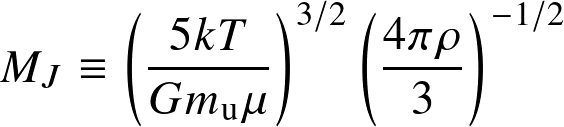
When
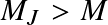 the total energy of the cloud decreases when it is perturbed. If we insert numerical constants for the numbers and write the densities in terms of the number density
 we obtain

Note some (giant) clouds have
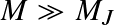 suggesting that the should collapse! In reality, these clouds feature additional support mechanisms (like magnetic support). Hence the condition
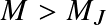 is a necessary but not (always) sufficient condition for collapse.
Star formation
— read CO 12.2 —
If the cloud is out of equilibrium, it collapses on a free-fall time
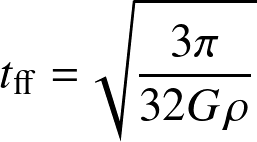
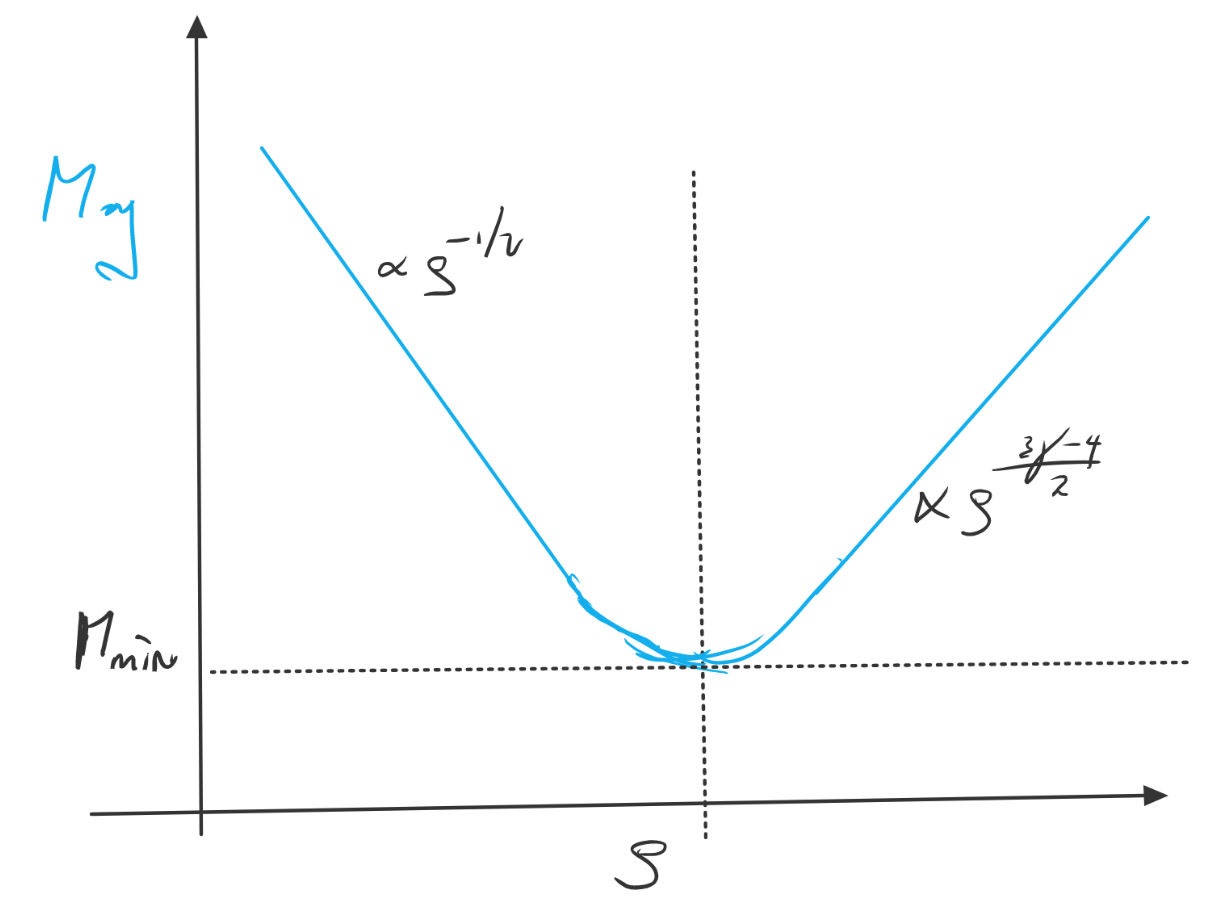
- During collapse of the cloud, ρ increases and the Jeans mass decreases. The cloud fragments with the fragments collapsing on their own.
- The isothermal collapse, requires efficient cooling.
- An increase in temperature, on the other hand, opposes cloud fragmentation, causing MJeans to rise
Star formation
— read CO 12.2 —
- An increase in temperature, on the other hand, opposes cloud fragmentation, causing MJeans to rise
By balancing the heat generated by the collapse
 with the expression
for blackbody radiation
with the expression
for blackbody radiation
 applicable when the cloud starts to cool less efficienty (
 becomes adiabatic) we can solve for the mass where the fragmentation terminates
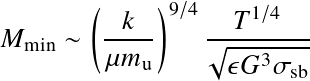
where I have omitted numerical factors and ε~0.1 is an efficiency factor. For T=103 K, we obtain
 .
.
This is of course an extremely crude estimate. But it tells that the protostar that forms at the end of the collapse state are of stellar mass — not of planet mass or the mass of galaxy. Further accretion onto this protostar will of course occur.
Star Formation
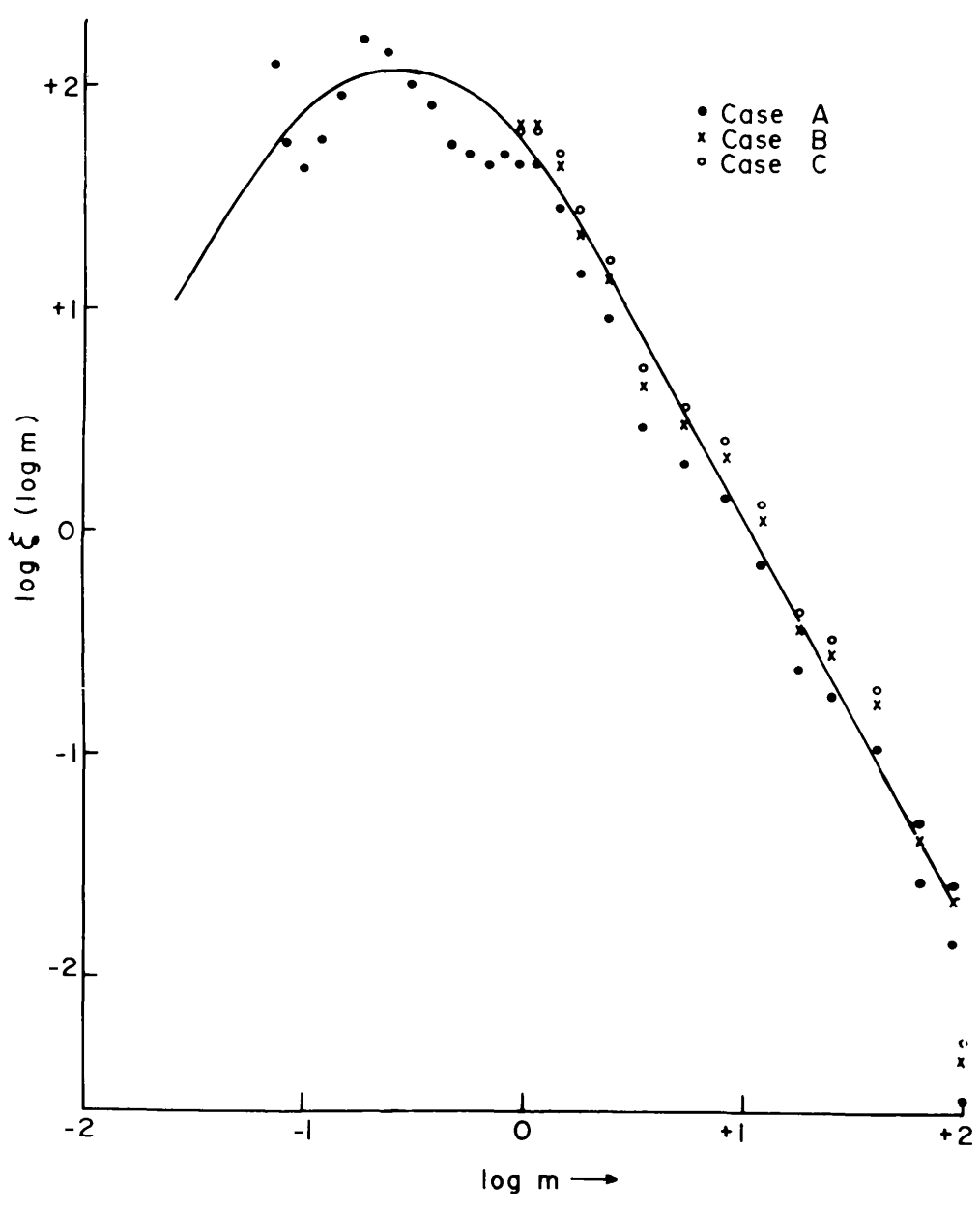
Initial mass function (IMF)
— read CO p.430 —
The Initial Mass Function or simply IMF is the distribution of stars formed by stellar mass
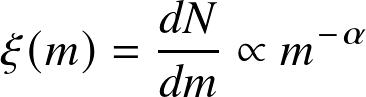
So ξ(m)Δm gives the number of stars that are formed in mass interval [m,m+Δm]
The IMF follows (steep) power-laws at high masses, but it turns over at low stellar masses (it has to!)
The origin of the IMF is an area of active research in star formation
Star formation — Classes
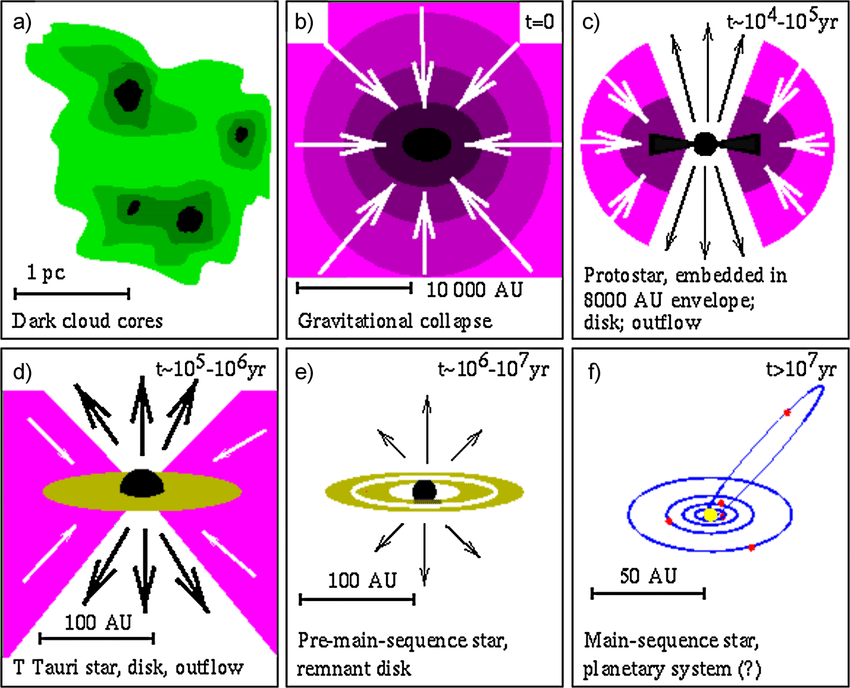
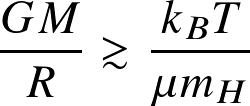
- Dark cores form and become unstable when their gravitational potential energy dominates thermal energy:
(mass exceeds Jeans mass)
![]()
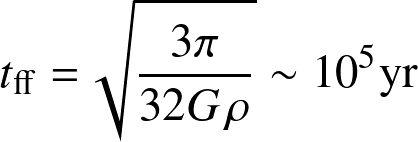
- The collapse takes place on the free-fall timescale
this is the embedded phase Class 0
![]()
Star formation — Classes
- A star has formed. Class 1. An outflow develops, while material is still accreting onto the star. A disks forms.
- Accretion and outflow weaken. This is the stage where planets are thought to form. Class 2 or the T-Tauri phase.
- After the gas clears, a
debris disks
may be left
Debris disk consist of solid material that did not assemble into planetary bodies. In the solar system the asteroid belt and the Kuiper belt are debris disks
- A planetary system emerges. The final architecture of the planet system is set when orbital stability is reached.
Dispersion Analysis
- Linear stability analysis
- Dispersion relationship for clouds and disks
- Toomre-Q criterion
- Giant planet formation and planetesimal formation
Dispersion relation
The fluid equations:
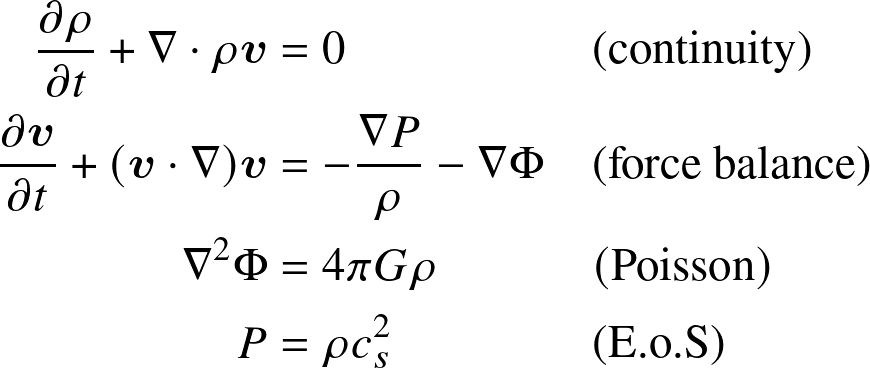
where the E.o.S is chosen as isothermal (constant temperature), such that cs — the isothermal sound speeed — is constant.
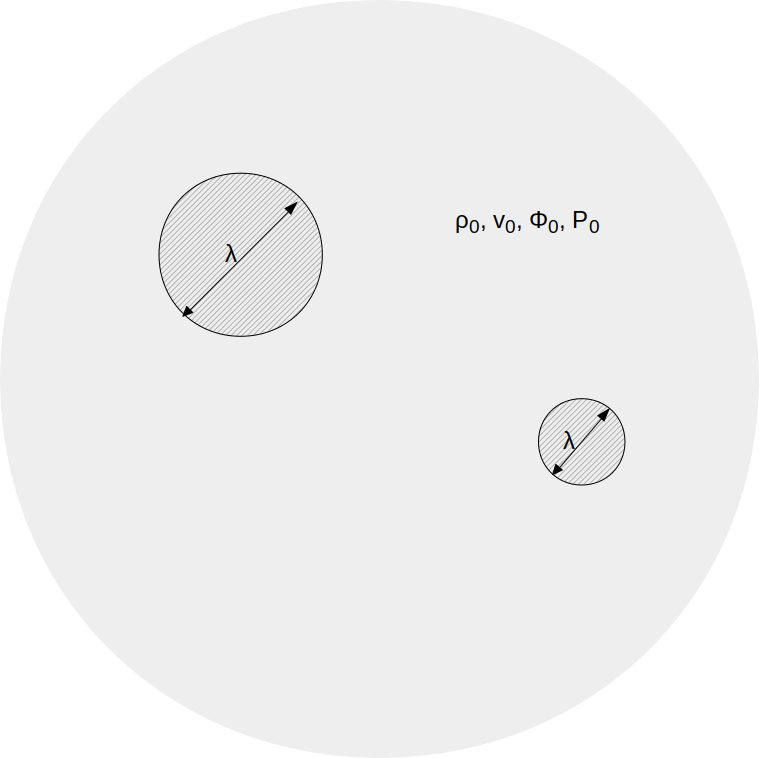
To 0th order, for a uniform cloud, the solutions to these equations read simply:

Dispersion relation
A linearly stability analysis quantifies how the system reacts to small perturbations that are wave-like in nature, e.g.,

with
 k the wavenumber and ω the frequency (or growth rate when it is imaginary!). Without loss of generality we have assumed that the wave travels in the x-direction. Note than ω can be complex, so the wave can grow (or decay)!
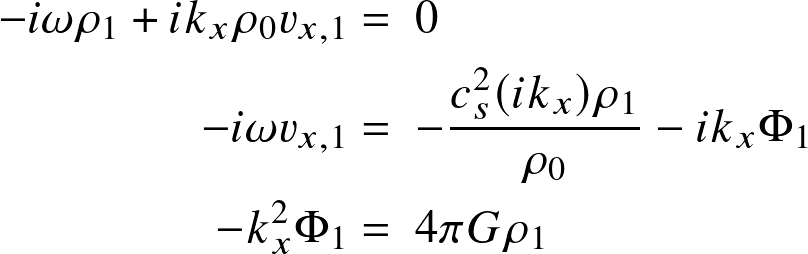
After some algebra, you arrive at the perturbation equations
Dispersion relation
The solution to the linearly stability analysis is the dispersion relationship:

A dispersion relationship is a relation between the scale of the perturbation (k) and the growth rate (ω).
We obtain:
- small scales (large k): ω2 is positive: perturbations remain wave-like and do not grow!
- large scales (small k): ω2 is negative: perturbations grow exponentially and are unstable!
- a critical scale
![]()
You can verify that
![]() amounts to the Jeans mass, barring a numerical coefficient
amounts to the Jeans mass, barring a numerical coefficient



Dispersion relation & planet formation
For disks the steady solution reads:

the assumption here is that the disk is thin. It does not need to be Keplerian rotating, but it should satisfy
 Also, we consider that the disk is axisymmetric (quantities do not depend on φ) and consider radial perturbations only (k oriented in the radial direction).
... and the dispersion relationship is

where
 is the epicycle frequency.
For a Keplerian potential
is the epicycle frequency.
For a Keplerian potential
 . Note that
 has a minimum corresponding to the critical wavelength.

Dispersion relation & planet formation
... and the dispersion relationship is

We obtain the following:
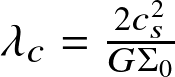
- The most critical wavelength is
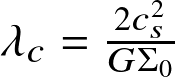
![]()
- The disk becomes gravitationally unstable when the
Toomre-Q
parameter
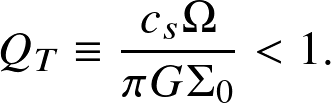
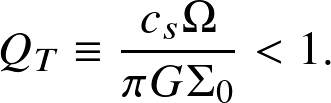
![]()
- The corresponding mass is
![]() .
.
Question:
Is QT <1 the only criterion for gravitational instability to result in collapse?

Dispersion relation & planet formation
... and the dispersion relationship is

We obtain the following:
- The most critical wavelength is
![]()
- The disk becomes gravitationally unstable when the
Toomre-Q
parameter
![]()
- The corresponding mass is
![]() .
.
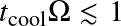
- In addition, gravitational collapse requires
fast enough cooling
Quantitatively
![]() .
Otherwise the formed clumps will just be sheared apart
.
Otherwise the formed clumps will just be sheared apart

Dispersion relation & planet formation
... and the dispersion relationship is

We obtain the following:
- The most critical wavelength is
![]()
- The disk becomes gravitationally unstable when the Toomre-Q parameter QT<1.
- In addition, gravitational collapse requires
fast enough cooling
- For dust particles,
![]() can be used, amounting to a critical scale of
can be used, amounting to a critical scale of
![]()
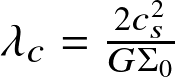
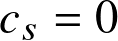

Hence, particles need to settle. The settling of particles is promoted by the stellar gravity, but opposed by turbulence.
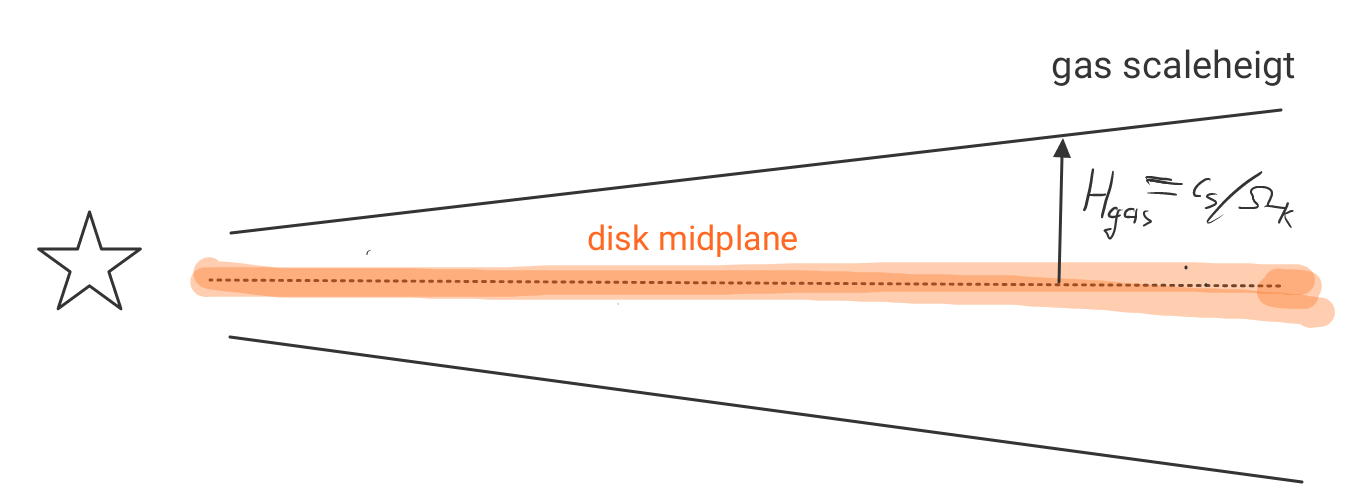
For the 2D analysis to remain valid, we must have
 (thin disks). In other words, particles must
settle
into a thin layer. This is the classical mechanism to form km-sized bodies (planetesimals), also known as the Goldreich-Ward mechanism, see Goldreich & Ward (1973)
(thin disks). In other words, particles must
settle
into a thin layer. This is the classical mechanism to form km-sized bodies (planetesimals), also known as the Goldreich-Ward mechanism, see Goldreich & Ward (1973)
effects of cooling
Smooth Particle Hydrodynamics (SPH) simulations of gravitational instability in disks
- standard (fast cooling)
- slow cooling
effects of cooling
Smooth Particle Hydrodynamics (SPH) simulations of gravitational instability in disks
- standard (fast cooling)
- slow cooling
Protoplanetary disks
What are we looking at?
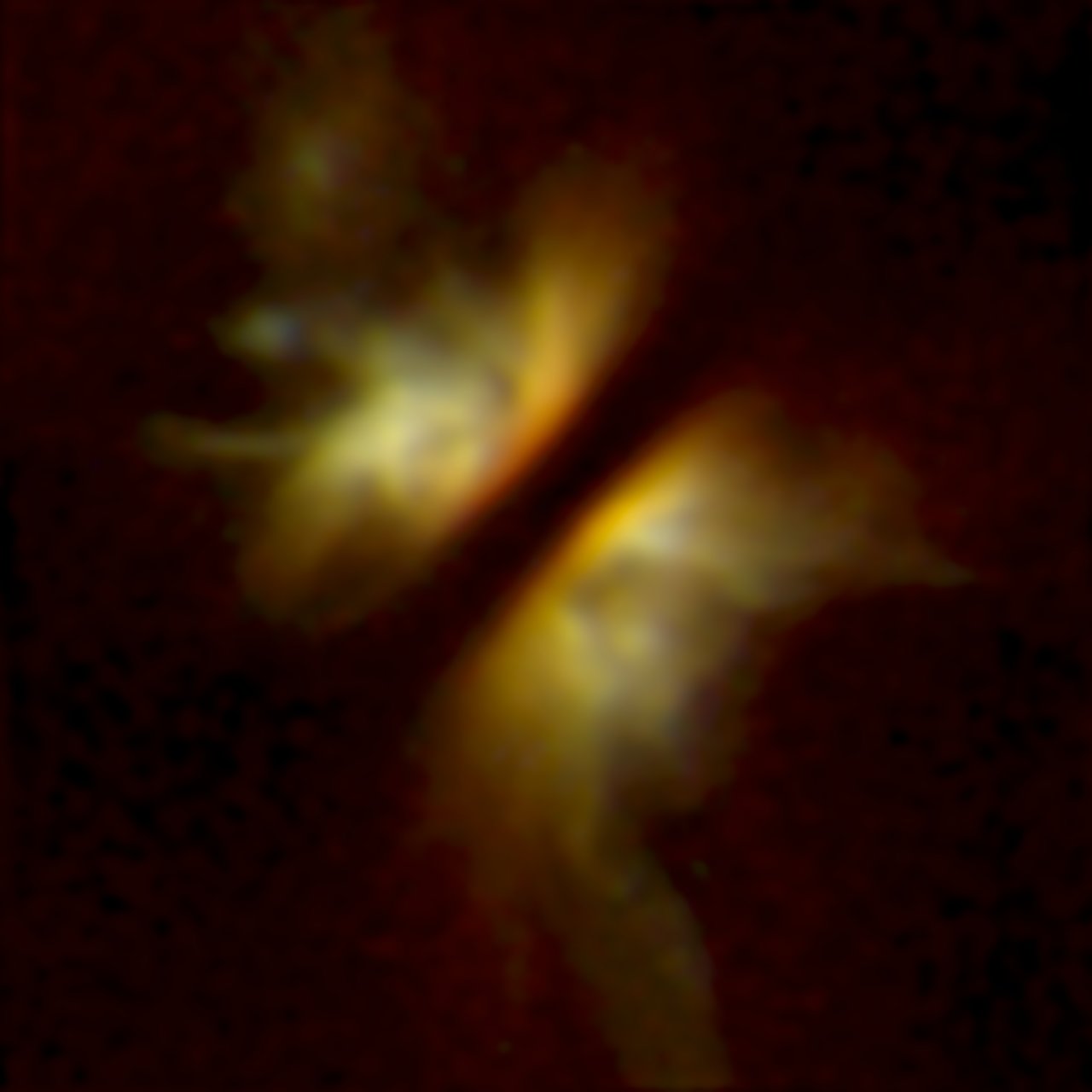
This is hl tau, observed at mm-wavelengths by ALMA. These wavelengths trace the large dust particles in the disk midplane. Intriguing axisymmetric structure —rings— appear
figure credit wikipedia/ESO
you are looking here at mm-wavelength emission
these wavelengths trace the disk midplane
figure credit: DSHARP survey, ALMA, ESO, NAOJ, NRAO, S. Andrews , Nicolas Lira; original data: DSHARP.
the protoplanetary disks (observations)
read CO p.437—441 & Ch.23.2
Properties
- disks are naturally formed as byproduct of star formation due to angular momentum conservation
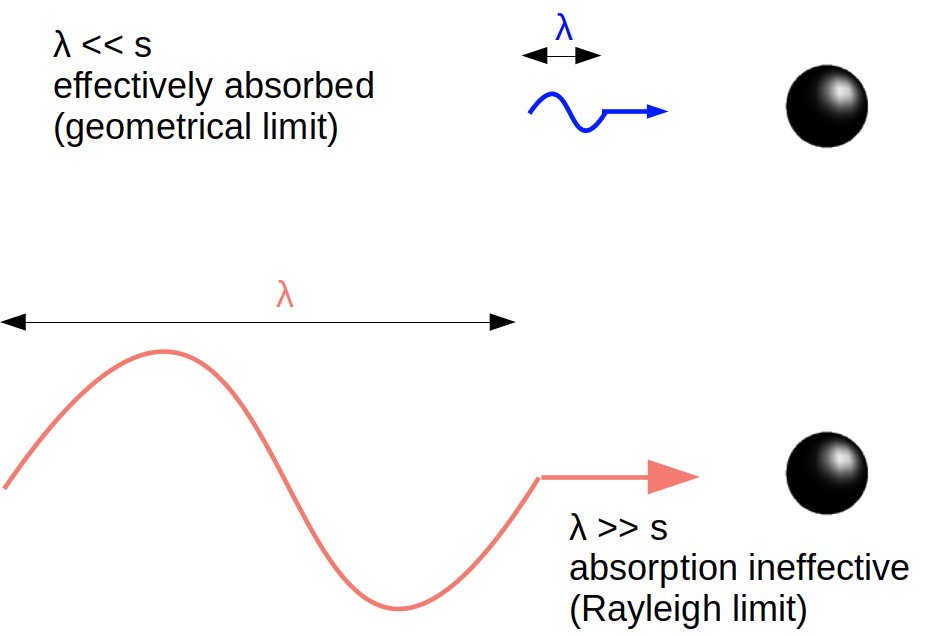
- disks are usually dusty, obscuring the interior disk midplane regions
the protoplanetary disks (observations)
read CO p.437—441 & Ch.23.2
Properties
- disks are naturally formed as byproduct of star formation due to angular momentum conservation
- disks are usually dusty, obscuring the interior disk midplane regions
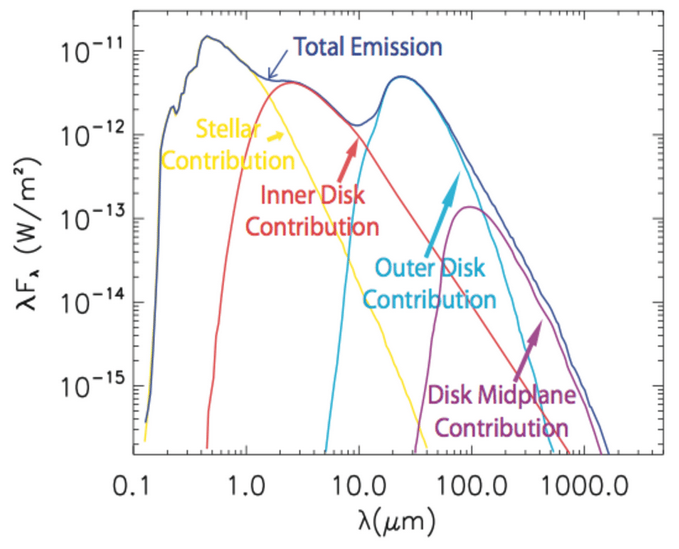
- the dust results in an
IR-excess
the total integrated emission is a superposition of several black body curves. The IR-excess is how disks were historically detected
the protoplanetary disks (observations)
read CO p.437—441 & Ch.23.2
Properties
- disks are naturally formed as byproduct of star formation due to angular momentum conservation
- disks are usually dusty, obscuring the interior disk midplane regions
- the dust results in an IR-excess
the protoplanetary disks (observations)
read CO p.437—441 & Ch.23.2
Properties
- disks are naturally formed as byproduct of star formation due to angular momentum conservation
- disks are usually dusty, obscuring the interior disk midplane regions
- the dust results in an IR-excess
-
Minimum-mass solar nebula (MMSN)
By spreading out the heavy element mass of the planets over rings, Weidenschilling (and Hayashi) obtained a crude prescription of the dust and gas density during the time of the formation of the planets. This prescription — known as the Minimum-Mass Solar Nebula — has many flaws, but serves as a useful benchmark. A frequently-used profile is:
![]()

→ Reconstruction of the early disk surface density from the current position of the planets in the solar system. Weidenschilling (1977)
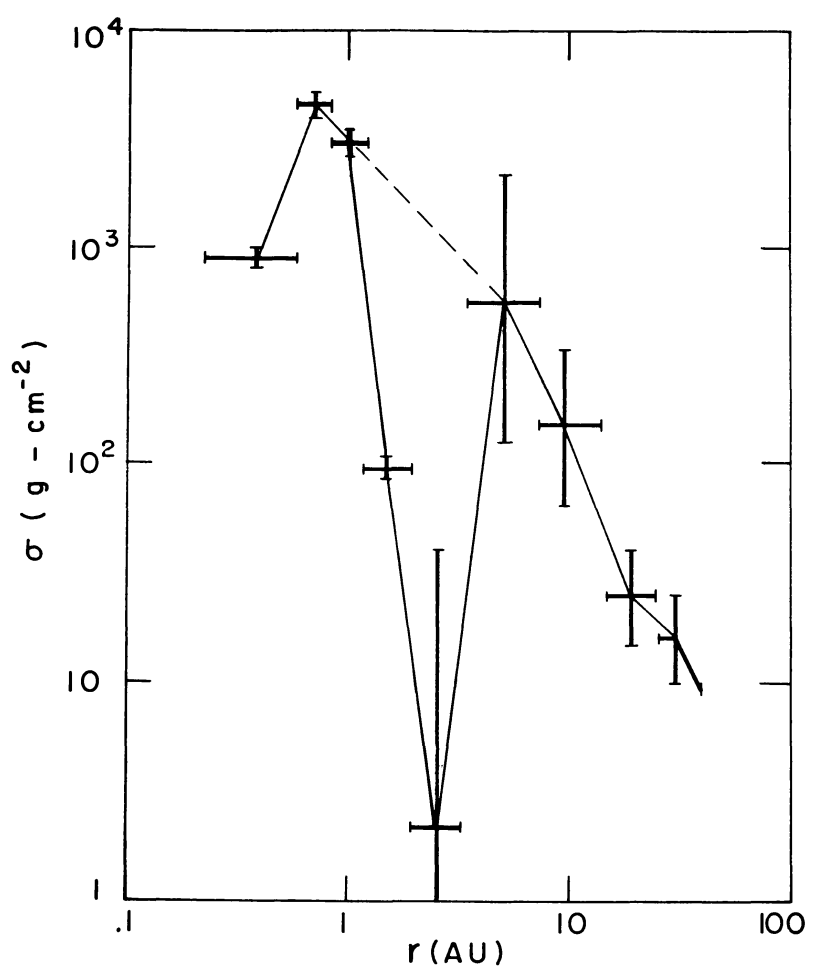
these numbers?
enough to fit a power-law!
the protoplanetary disks (observations)
read CO p.437—441 & Ch.23.2
Properties
- disks are naturally formed as byproduct of star formation due to angular momentum conservation
- disks are usually dusty, obscuring the interior disk midplane regions
- the dust results in an IR-excess
- Minimum-mass solar nebula (MMSN)
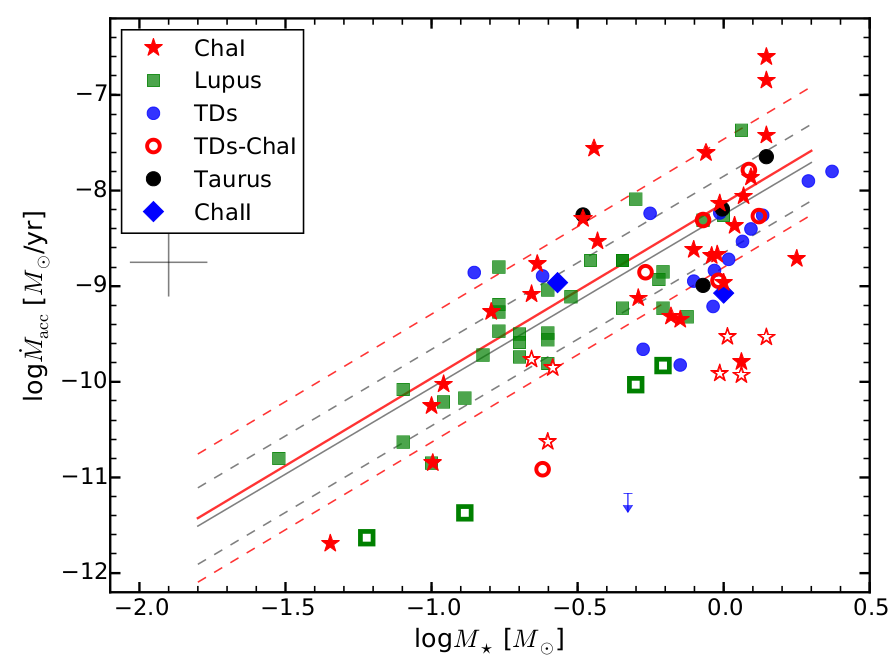
- disks are observed to
accrete
onto their host star at rates of
![]()
Mass and angular momentum are being transported.

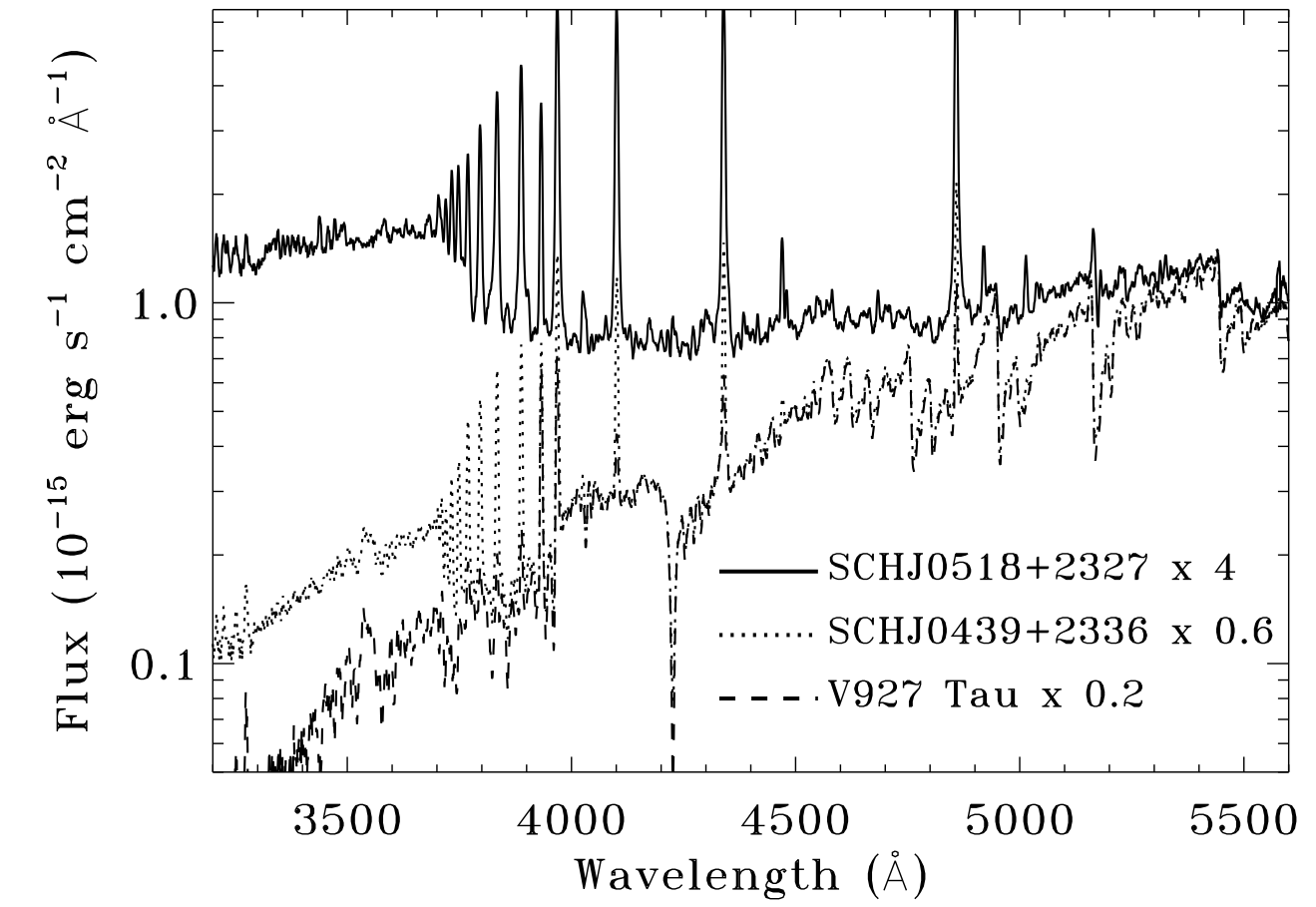
The emission lines can be modeled, which provides the accretion luminosity Lacc. The accretion luminosity and accretion rate are related through:

the protoplanetary disks (observations)
read CO p.437—441 & Ch.23.2
Properties
- disks are naturally formed as byproduct of star formation due to angular momentum conservation
- disks are usually dusty, obscuring the interior disk midplane regions
- the dust results in an IR-excess
- Minimum-mass solar nebula (MMSN)
- disks are observed to
accrete
onto their host star at rates of
![]()
Mass and angular momentum are being transported.

the protoplanetary disks (observations)
read CO p.437—441 & Ch.23.2
Properties
- disks are naturally formed as byproduct of star formation due to angular momentum conservation
- disks are usually dusty, obscuring the interior disk midplane regions
- the dust results in an IR-excess
- Minimum-mass solar nebula (MMSN)
- disks are observed to
accrete
onto their host star at rates of
![]()
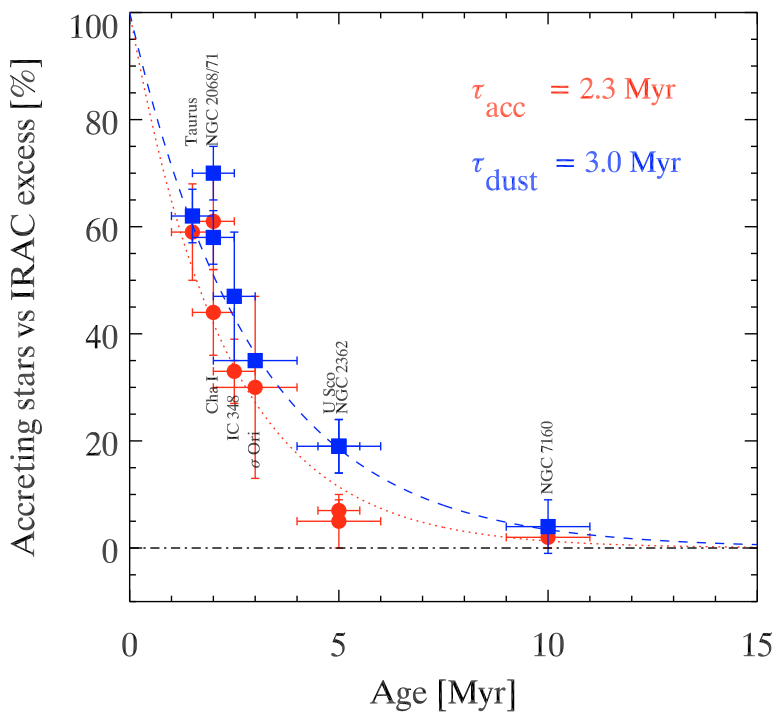
- Accretion terminates over timescales of ~Myr
A natural explanation is that the gas disk is gone after several Myr. It sets a timescale for the formation of gas giant planets

Elements of planet formation


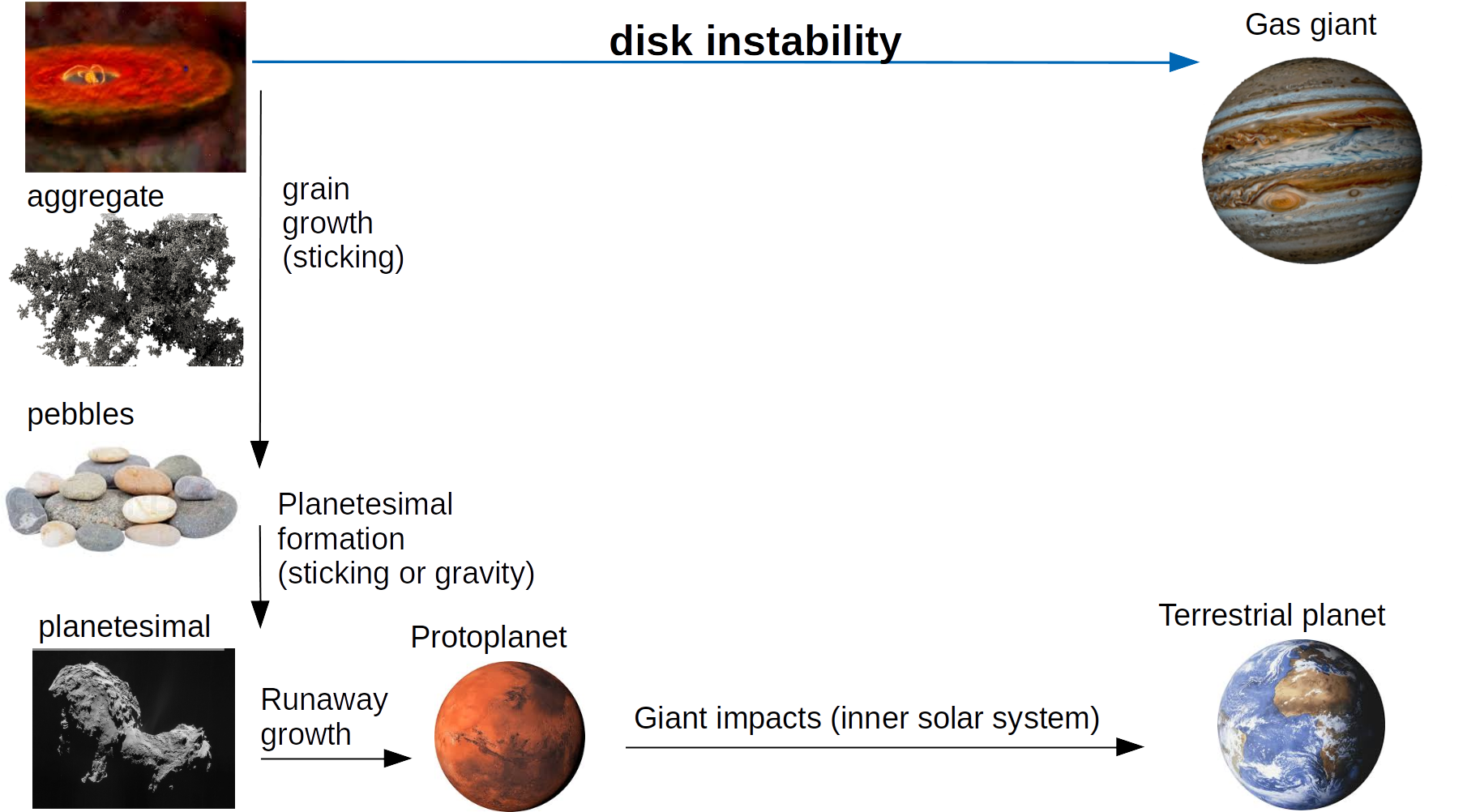
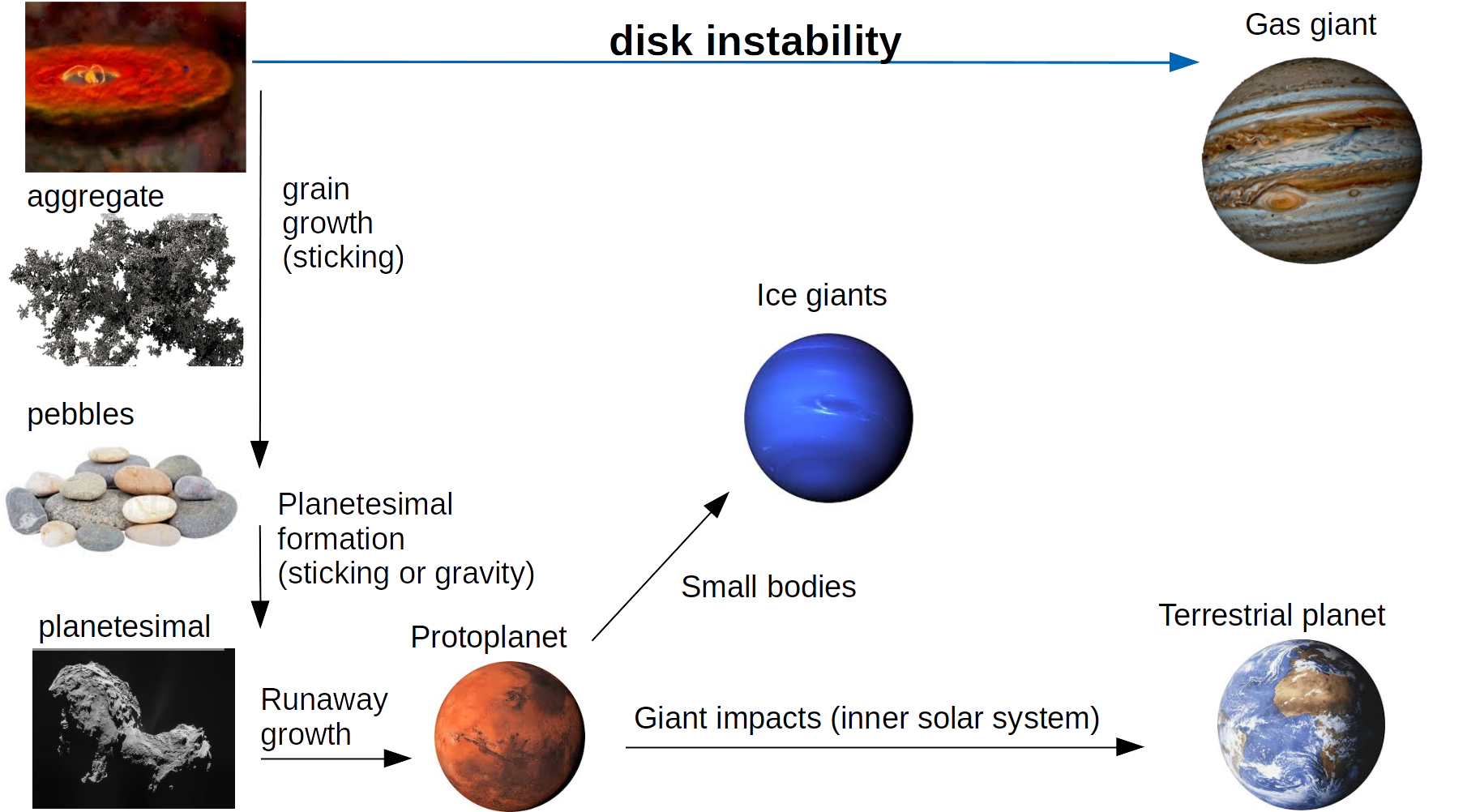
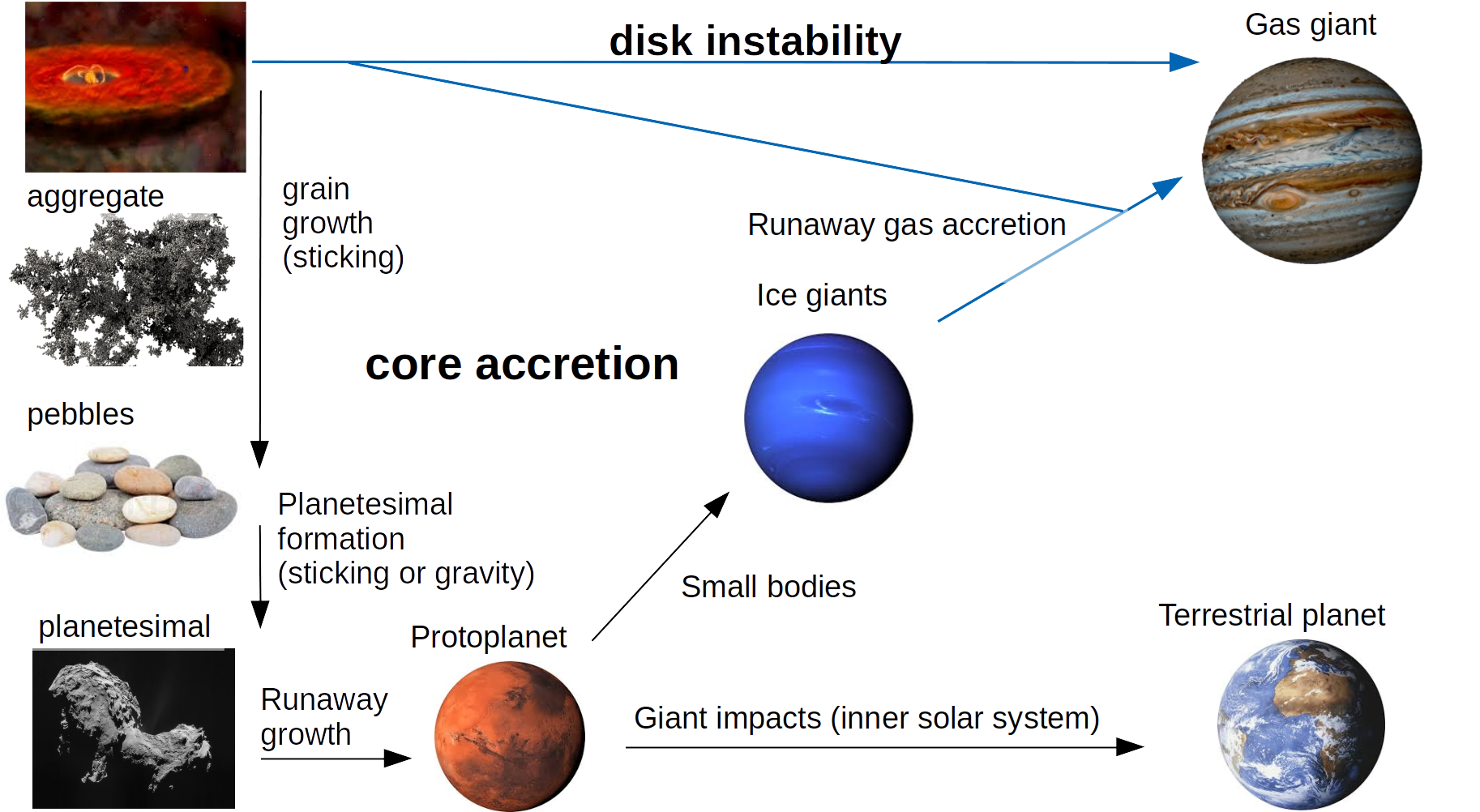
Core accretion and Disk instability
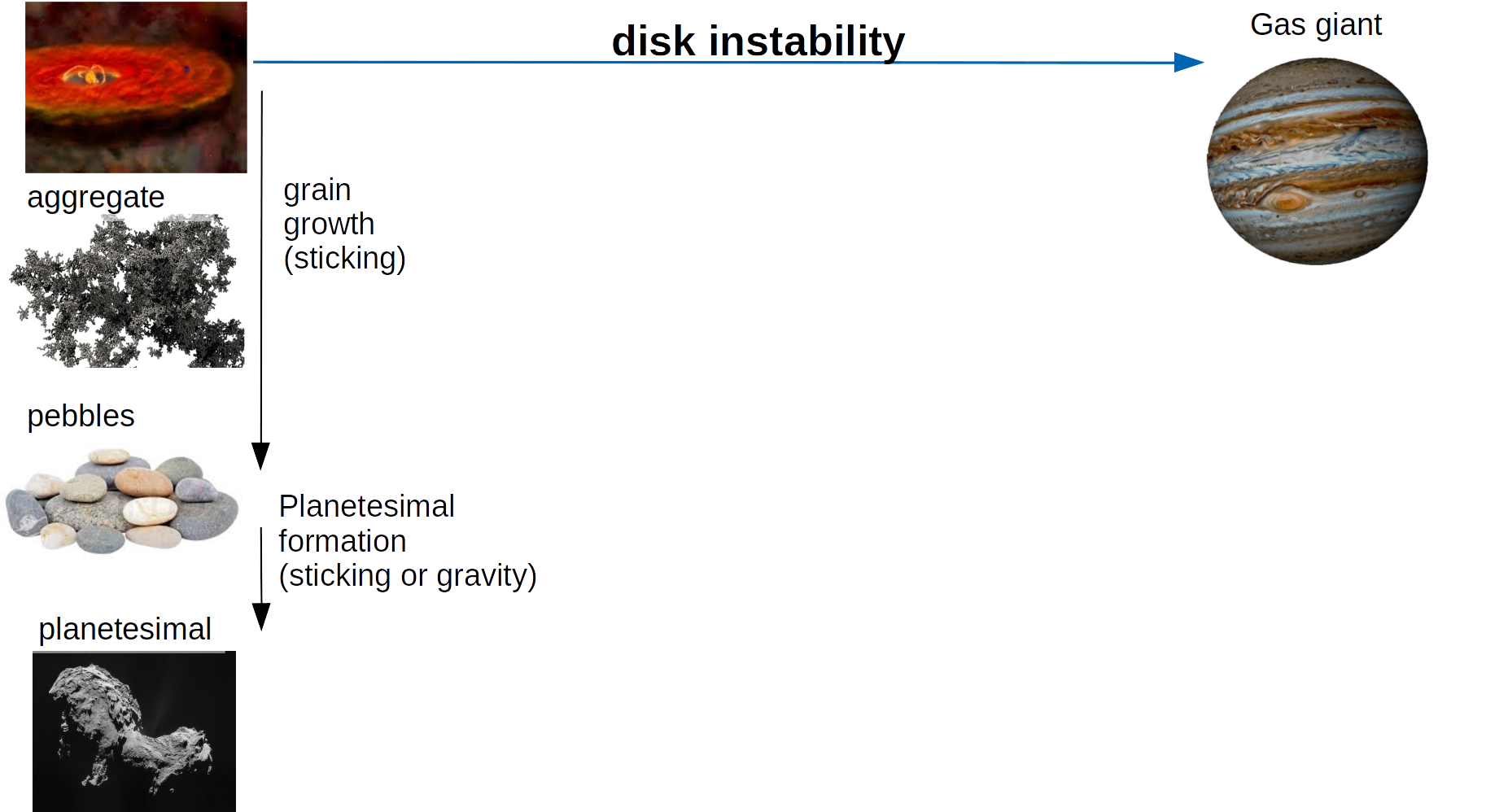
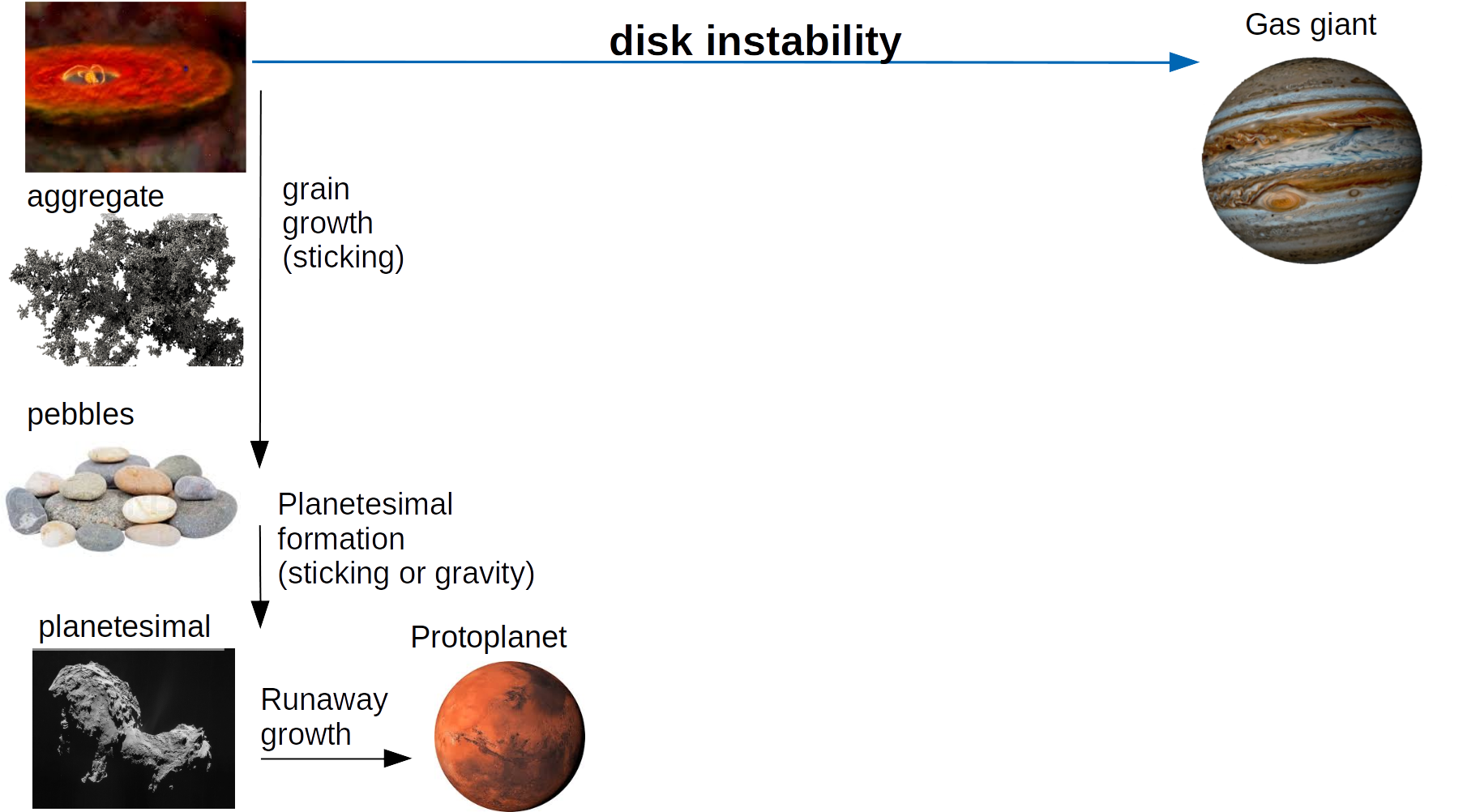
There are two main paradigms for the formation of planets:
- disk instability: planets form following a gravitational instability in the gas disk
-
core accretion:
planet formation occurs bottom-up by coagulation (collisions between solid particles)
—initially, solids stick due to surface forces
—later, bodies are held together by gravity
(at intermediate sizes sticking is problematic)
end of module 5
—congrats—