RESEARCH / FAST RADIO BURSTS

Fast Radio Bursts

Exploring burst activity and the environments of cosmic radio transients.

Fast radio bursts offer a way to study short-duration energy release and the magnetized material around compact objects. Our research connects FAST surveys and long-term monitoring with burst statistics, polarization, host-galaxy observations and reproducible analysis tools.

SCIENCE

Research highlights

Selected studies · 2021–2025

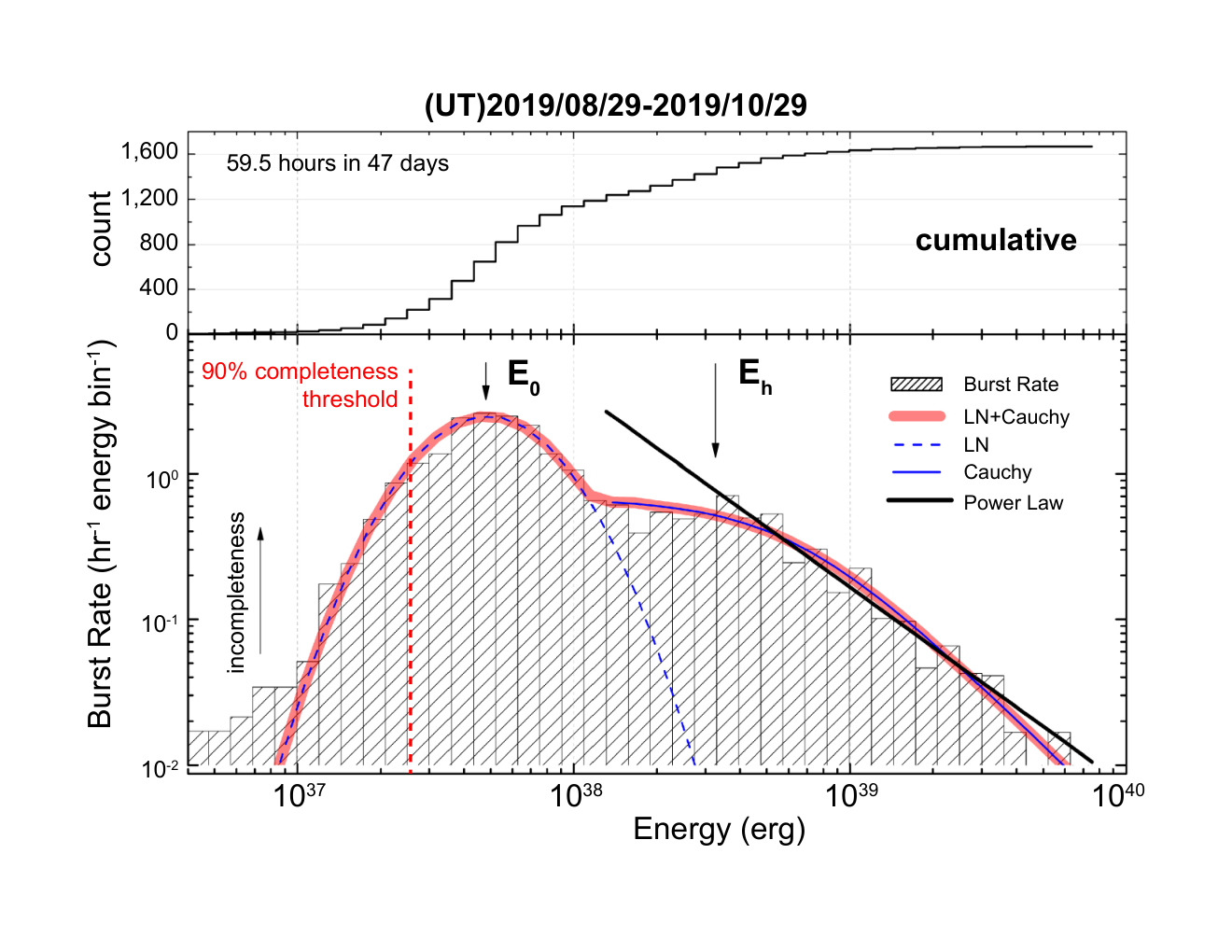
Cumulative burst counts and the measured burst-energy distribution of FRB 20121102A
Li et al. (2021), Fig. 2, author manuscript. Image source ↗

A bimodal burst energy distribution

A FAST campaign recorded 1,652 bursts from FRB 20121102A. Their energy distribution exhibits a bimodal structure, offering a quantitative benchmark for models of burst activity and energy release. This study also characterizes the statistical behaviour of a well-sampled repeating source.

Li, D., Wang, P., Zhu, W. W., et al.
Read the paper ↗arXiv ↗
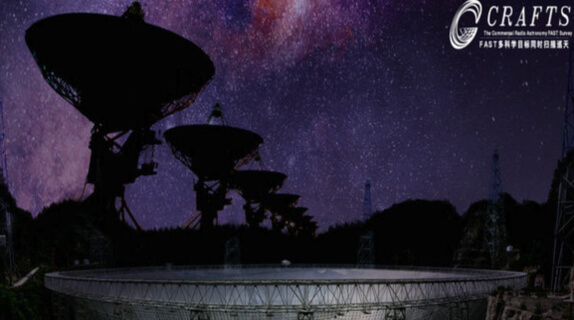
CRAFTS illustration showing FAST and the radio telescopes involved in the study of FRB 20190520B
NAOC / CRAFTS discovery illustration. Image source ↗

FRB 20190520B: an active repeater

Discovered by CRAFTS and localized with follow-up observations, FRB 20190520B is associated with a compact persistent radio source in a dwarf galaxy. Its dense plasma environment makes it a useful target for studying how repeating FRBs and their immediate surroundings evolve.

Niu, C.-H., Aggarwal, K., Li, D., et al.

Read the paper ↗Research story ↗
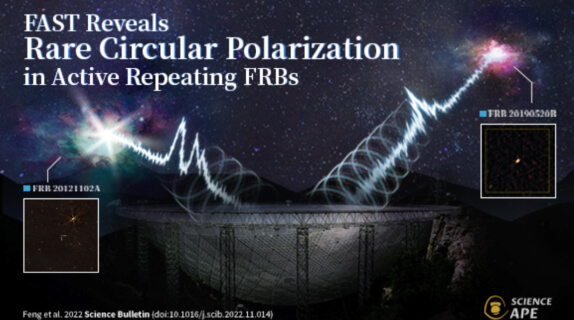
Illustration of circularly polarized radio bursts from FRB 20121102A and FRB 20190520B
ScienceApe / NAOC illustration for Feng et al. (2022). Image source ↗

Polarization as an environmental probe

Polarization varies with observing frequency and with individual bursts. Measurements of depolarization and rare circularly polarized bursts provide complementary constraints on the magnetized plasma near repeating FRBs and on the propagation of their radiation. This entry brings together two studies published in 2022.

Feng, Y., Li, D., Yang, Y.-P., et al.; Feng, Y., Zhang, Y.-K., Li, D., et al.

Frequency dependence ↗Circular polarization ↗
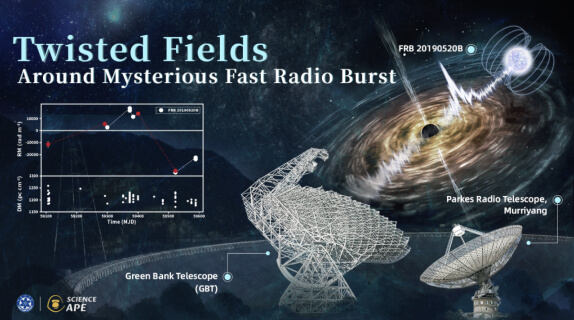
Illustration and rotation-measure time series of the changing magnetic environment around FRB 20190520B
Di Li / ScienceApe / CAS illustration. Image source ↗

Magnetic-field reversals around a repeating FRB

Seventeen months of monitoring revealed large changes in the Faraday rotation of FRB 20190520B, including two sign reversals. The observations trace a changing line-of-sight magnetic field and are consistent with propagation through turbulent magnetized plasma, including a possible companion-star wind.

Anna-Thomas, R., Connor, L., Dai, S., et al.

Read the paper ↗arXiv ↗
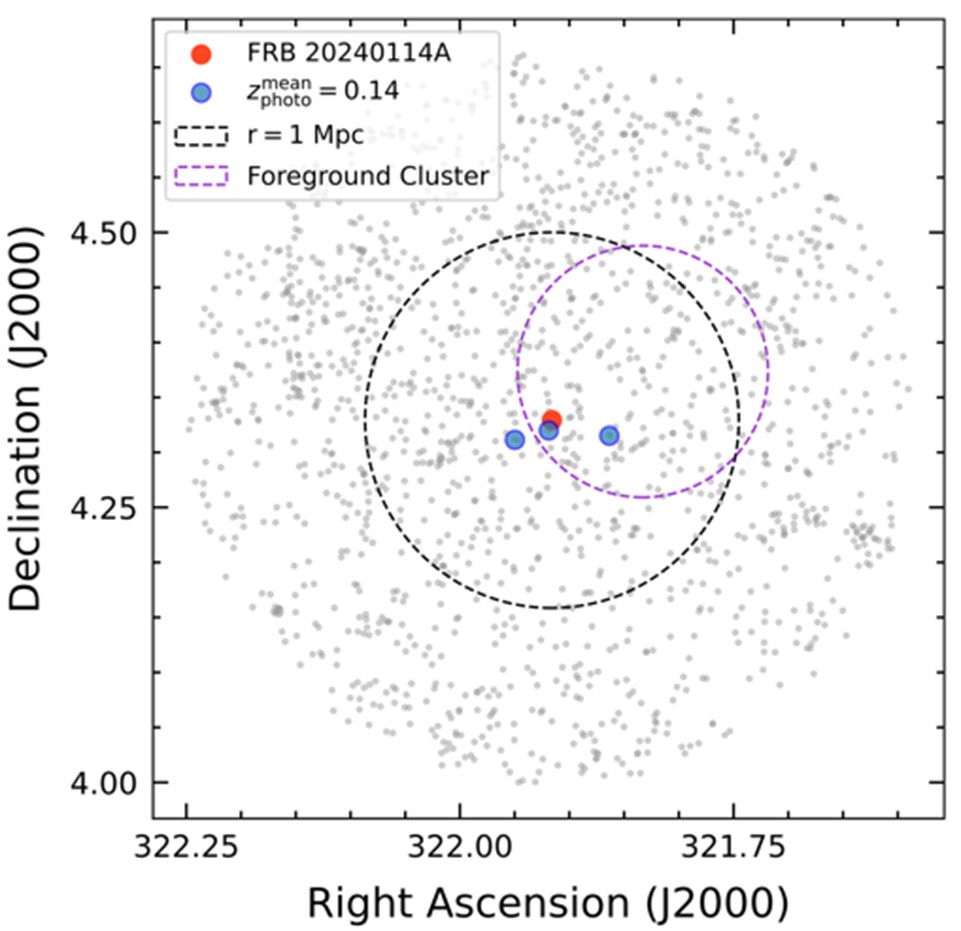
Sky distribution of FRB 20240114A, nearby galaxies and a foreground galaxy cluster
Chen et al. (2025), reproduced in the NAOC report. Image source ↗

Connecting repeaters to their host galaxies

Optical and near-infrared observations of FRB 20190520B and FRB 20240114A connect their activity to star-forming dwarf galaxies. Spectroscopy maps ionized gas and helps separate host-galaxy and foreground contributions to dispersion measure, linking the FRBs' environments with material along their sightlines.

Chen, X.-L., Tsai, C.-W., and collaborators.

FRB 20190520B ↗FRB 20240114A ↗Research story ↗

METHODS & OPEN RESOURCES

Tools & data

From finding bursts to comparing their behaviour.

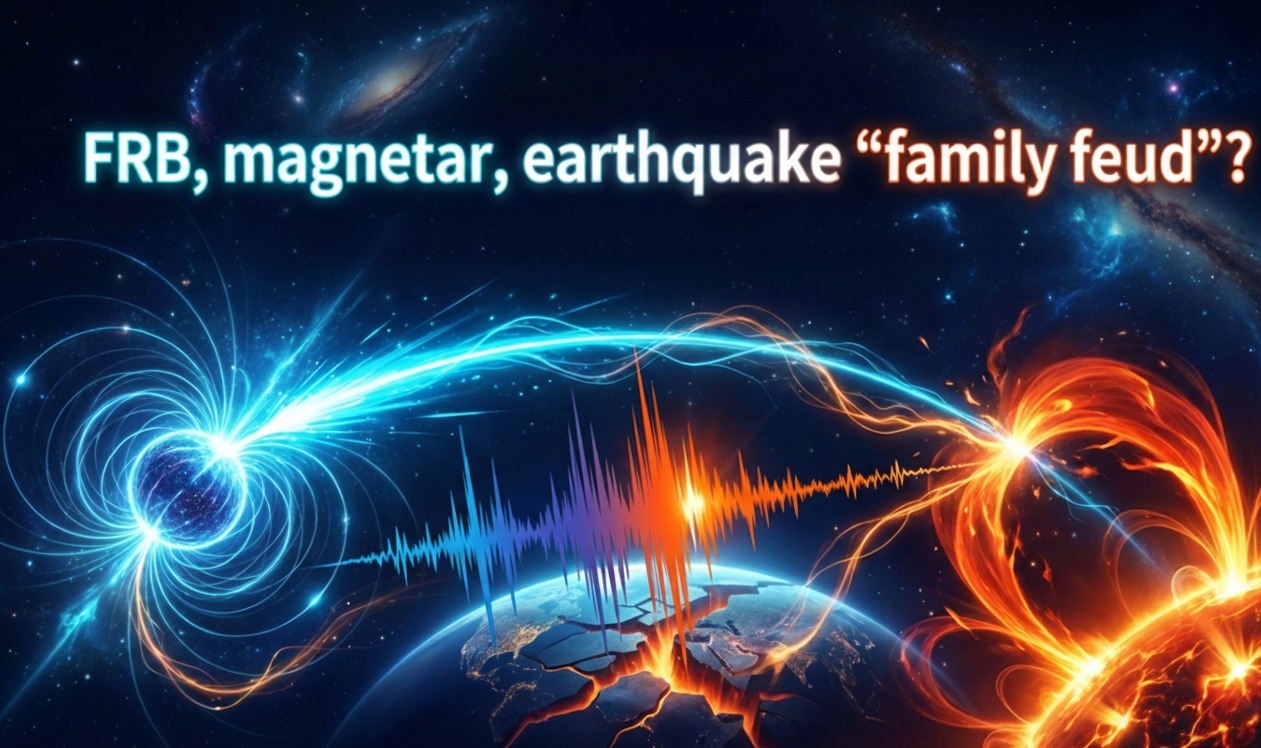
PLD Explorer illustration comparing fast radio bursts, magnetars and earthquakes
Project artwork from PLD Explorer. Project source ↗

PLD Explorer: burst-sequence dynamics

Compare transient-event sequences in a Pincus–Lyapunov diagram, using published reference values or your own time–energy data. The browser-based explorer connects earlier work on FRB time–energy statistics with a wider comparison of FRBs, magnetars, pulsar glitches, earthquakes and solar flares.

Zhang et al. (2024), Science Bulletin; Xu et al. (2026), SCPMA.

Open PLD Explorer ↗2026 paper ↗2024 background ↗
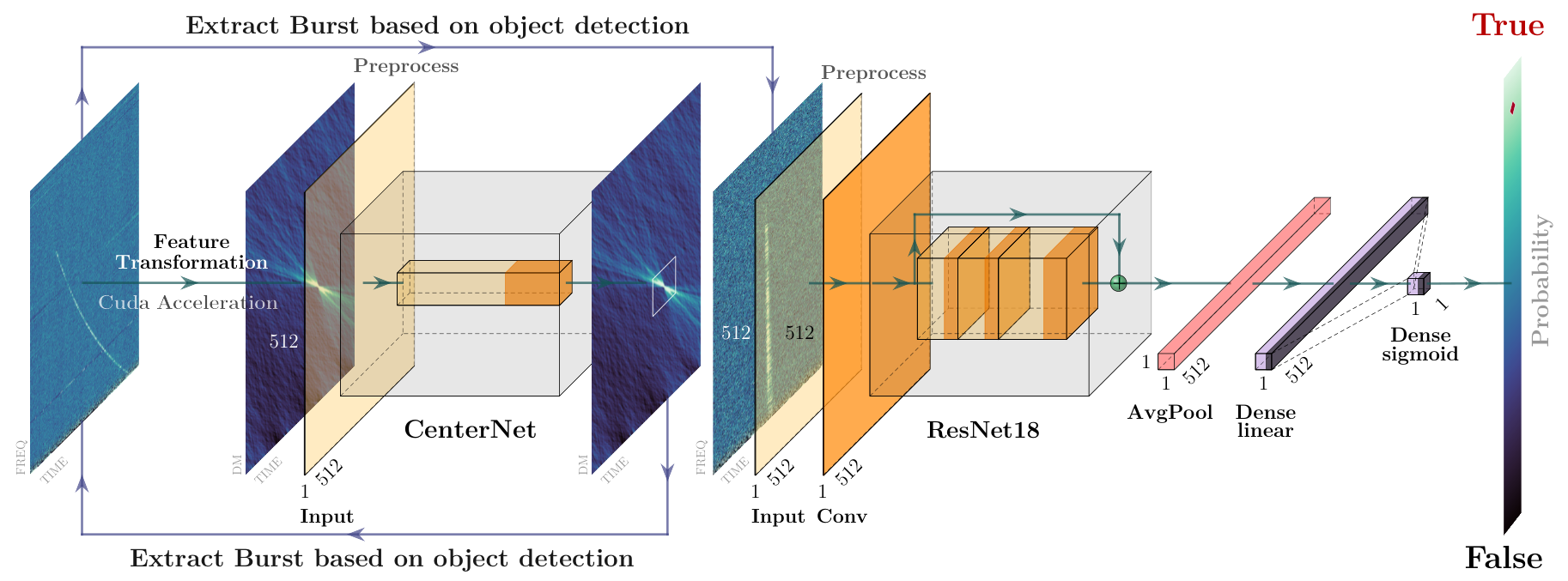
DRAFTS workflow combining object detection with a ResNet classifier to identify radio bursts
Zhang et al., DRAFTS, Fig. 2, author manuscript (CC BY 4.0). Image source ↗

DRAFTS: finding radio transients with deep learning

DRAFTS combines object detection and classification to search radio-telescope observations for short transients. Developed and tested with FAST data, the pipeline supports reproducible FRB searches through public code, models and training data, connecting burst discovery with detailed population studies.

Zhang, Y.-K., Li, D., Feng, Y., et al.

Code & documentation ↗Read the paper ↗Training data ↗
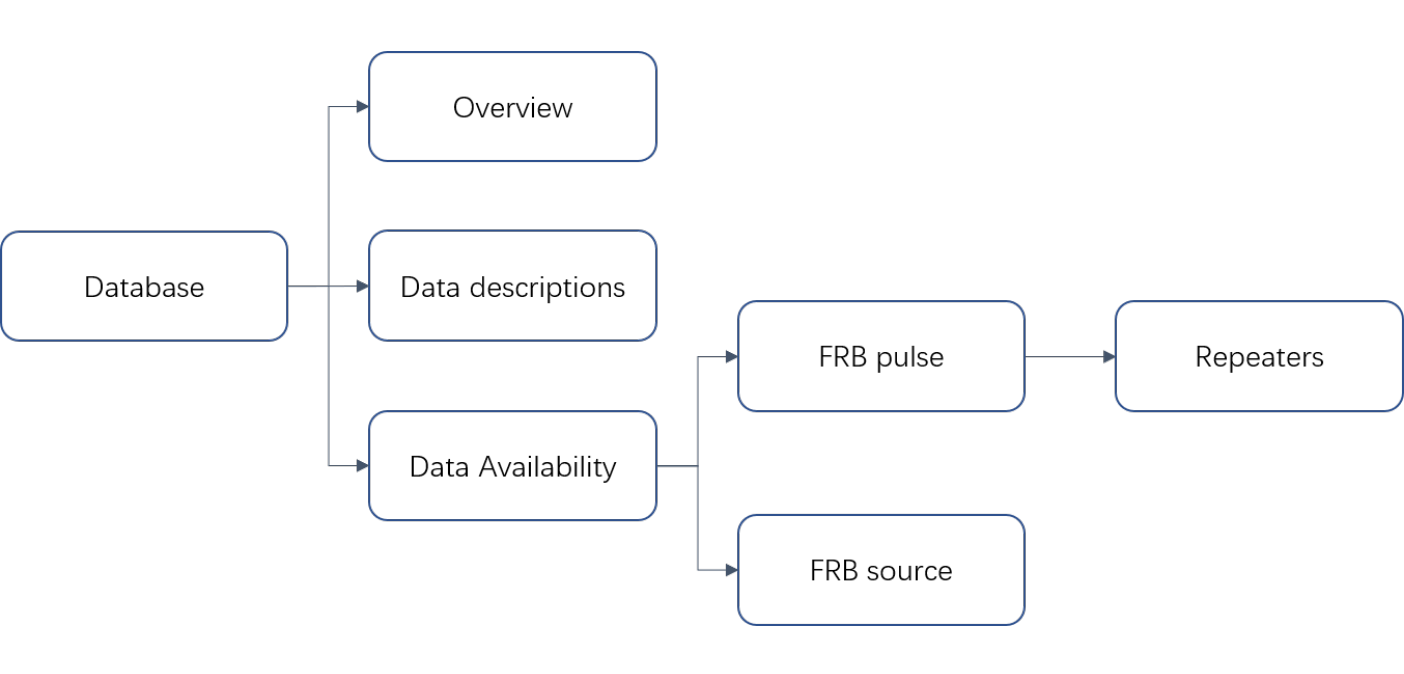
Blinkverse database structure linking FRB source records, pulse records and repeating sources
Xu et al. (2023), Fig. 1, database structure. Image source ↗

Blinkverse: a database of fast radio bursts

Blinkverse collects published FRB properties and dynamic spectra from multiple observatories. Parameter searches and interactive visualization support comparisons between bursts and repeating sources. Its accompanying paper describes the database structure and demonstrates statistical analyses using the collected observations.

Xu, J., Feng, Y., Li, D., et al.

Read the paper ↗