Lecturer
Dongzi Li
Fast radio bursts, plasma lensing, and radio transient astrophysics.
Personal webpage · EmailOffice hours: Physics Building E222, Thursday 09:00–10:00
An introduction to white dwarfs, neutron stars, black holes, and gravitational waves, connecting stellar evolution and fundamental physics with modern astronomical observations.
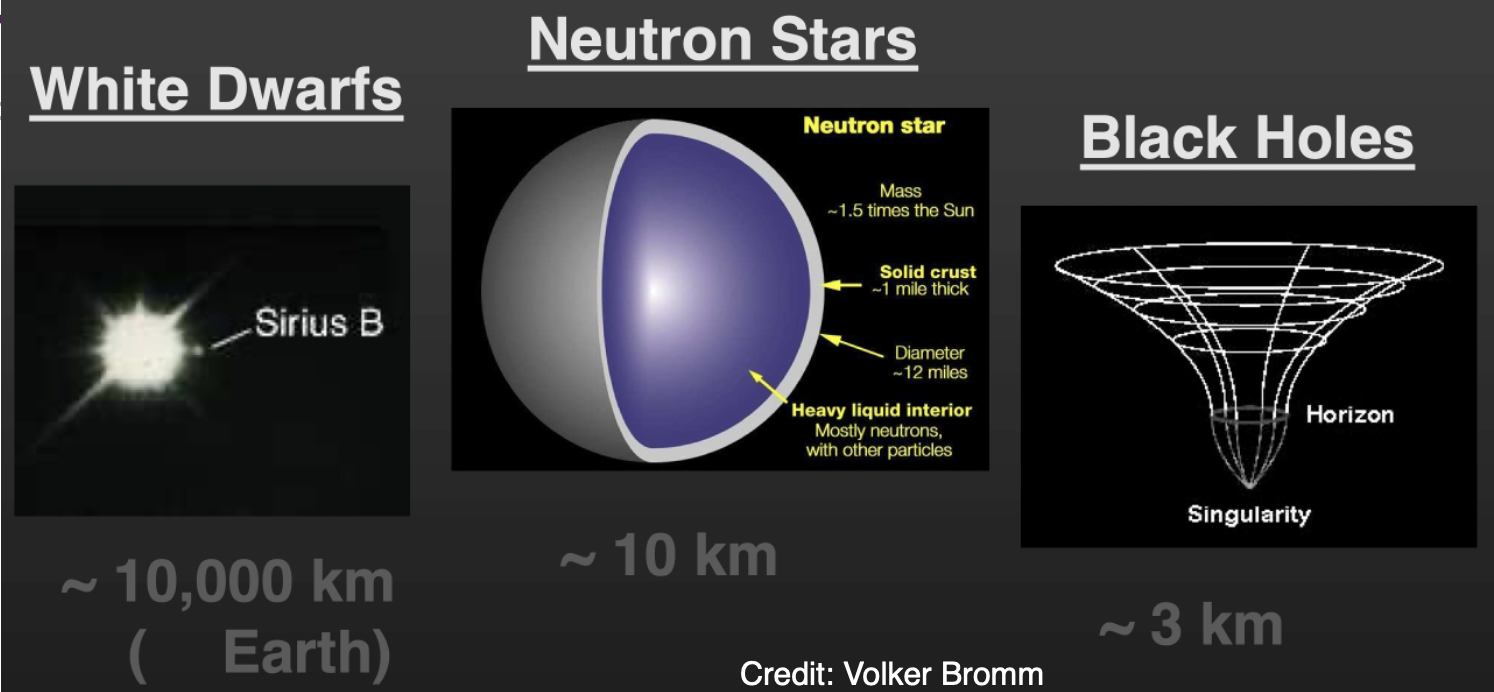
Figure credit: Volker Bromm
Compact objects are the endpoints of stellar evolution. White dwarfs and neutron stars are supported by quantum degeneracy pressure, while black holes provide direct tests of general relativity in the strong-gravity regime.
The course examines their formation, structure, and observational signatures through binary systems, supernovae, pulsars, fast radio bursts, active galactic nuclei, and gravitational waves.
Fast radio bursts, plasma lensing, and radio transient astrophysics.
Personal webpage · EmailOffice hours: Physics Building E222, Thursday 09:00–10:00
Exoplanets, gravitational microlensing, and astronomical data analysis.
Personal webpage · EmailOffice hours: Physics Building E318, Tuesday 09:00–10:00
Course assistance, reading presentations, and written assignments.
cw26@mails.tsinghua.edu.cnEach entry combines the weekly schedule with the related teaching materials retained from the original webpage.
Research history, formation channels, black-hole density, and astrophysical classification.
Magnitudes and the H–R diagram; stellar structure equations; nuclear reactions; evolution and nucleosynthesis.
Electron degeneracy, mass–radius relation, Chandrasekhar mass, and stellar structure and evolution.
Lagrange points, Roche lobes, mass transfer, common envelopes, cataclysmic variables, novae, and Type Ia supernovae.
Gravitational redshift, lensing, orbital precession, Shapiro delay, and gravitational radiation.
Core-collapse supernovae, SN 1987A, the TOV equation, and neutron-star mass limits.
Discovery and nature; rotation-powered and millisecond pulsars; astrophysical applications.
Gamma-ray bursts, relativistic jets, and fast radio bursts: observations and physical models.
Kerr spacetime, black-hole spin, particle motion, thermodynamics, Hawking radiation, and primordial black holes.
X-ray sources, observational evidence, accretion, Eddington luminosity, discs, and spin.
AGN observational characteristics, unified models, accretion, reflection spectra, and mass measurements.
The Galactic Centre, nearby-galaxy black holes, direct imaging, and SMBH evolution.
Sources, amplitudes and frequencies, laser interferometers, detector noise, and compact-binary waveforms.
Introduction to current research topics and preparation for final presentations.
Student presentations and discussion.
Preparation and active engagement in class.
One 20-minute presentation per student.
Four assignments during the semester.
In-class presentation at the end of term.
No final examination.